
 By
Every fall, diesel pickup owners start asking the same question: at what temperature does diesel gel, and what should I do before it happens? You know what gelled fuel does to a truck. The engine cranks and dies, or it will not start at all. What you need are clear numbers and a plan.
I built this FAQ from what fuel makers, engine makers, and additive companies publish about cold weather diesel. I kept the answers that help a pickup owner make decisions. I chose the products I mention based on how clearly the maker explains what each one does and how to use it.
You will find the temperatures to watch, the reasons pickups have more trouble than big rigs, a simple prevention routine, and a rescue plan if the fuel gels anyway.
At what temperature does diesel gel?
Standard No. 2 diesel starts to form wax crystals at about 15°F to 20°F. That is called the cloud point. The fuel looks hazy at that stage, and it still flows.
As the temperature keeps dropping, the crystals grow and stick together. Somewhere in the single digits or below, the fuel can turn thick and stop moving through the lines. The exact number depends on your fuel, so treat any single number as a guide.
What is the difference between cloud point and gel point?
These two terms describe two stages of the same problem.
- Cloud point: The temperature where wax crystals first appear. The fuel turns cloudy.
- Gel point: The temperature where the crystals lock together and the fuel stops flowing like a liquid.
Your filter can clog at the cloud point stage, well before the whole tank gels. That is why I tell pickup owners to act when the forecast nears 20°F, not when it reaches zero.
Why do pickups have more trouble than big trucks?
A diesel pickup has a smaller fuel filter than a semi has. A small filter has less surface area, and wax crystals can block it fast. Howes notes that smaller vehicles like diesel pickups and tractors are more prone to gelling even when the fuel is treated.
Pickups also sit outside overnight, and many owners fill up less often than a fleet does. Old fuel in the tank may be a summer blend that was never meant for cold weather.
Does winter blend fuel solve the problem?
It helps, but it does not remove the risk. Stations in cold regions switch to winter blends, which have a lower cloud point. If you buy fuel in a warm area and drive north, you may carry fuel that is not ready for the cold. A blend that works at 10°F will not help at minus 10°F.
Ask your station what the fuel is rated for. Then treat your tank anyway.
How do I prevent diesel from gelling?
Follow a routine each winter. These steps are simple and they work together.
1. Replace your fuel filter before the cold season starts.
2. Add an anti-gel to the tank before the temperature drops, and add it at every fill-up.
3. Keep the tank at least half full. A fuller tank leaves less room for moisture to collect.
4. Park out of the wind when you can.
5. Keep a rescue product in the cab.
Which anti-gel do I recommend?
I recommend Howes Diesel Treat. Howes is a fifth-generation, family-owned company in North Kingstown, Rhode Island, and they have made fuel additives and lubricants since 1920. They call Diesel Treat North America’s number one trusted anti-gel and fuel conditioner.
Here is why it stands out for pickup owners:
- It prevents gelling in very cold climates and deals with problems linked to ultra low sulfur diesel.
- It adds lubricity to injectors, pumps, and upper cylinders.
- It uses detergents to help prevent injector deposits and reduces cold filter plugging.
- It pushes water out of the fuel so your water separator can remove it. Some competing products mix water into the fuel. Howes says major diesel engine makers prefer the method they use.
- It is warranty safe and particulate filter friendly, and it works in all diesel and biodiesel blends.
Howes lists the standard treat rate at 1 ounce per 5 gallons above 0°F and 1 ounce per 2.5 gallons below 0°F. They say pickups need a double dose, so read the label for your truck. They also state that overtreating is not harmful, which takes worry out of the process.
Howes backs Diesel Treat with a Winter Tow Guarantee. If a truck treated with the product fails to keep going in winter, they will pay for the tow. Every Howes product also carries a 100 percent satisfaction guarantee. Read the terms before you buy.
What if my fuel has already gelled?
An anti-gel cannot reverse gelling once the fuel passes its cloud point. It works as prevention. For a truck that is already stuck, you need a rescue product.
Howes makes Diesel Lifeline for this case. It changes the melting points of wax and ice crystals so frozen diesel flows again. It also de-ices frozen fuel filters and helps prevent new icing.
Here is what Howes says about it:
- It often works in about 15 minutes.
- It is proven in temperatures down to minus 35°F and below.
- It contains no alcohol or harmful solvents.
- You do not need to mix it with other diesel first. You pour it into the tank or the filter.
- It removes the need to replace the fuel filter.
Lifeline comes in quart and half-gallon sizes. I suggest you keep a bottle in the cab or toolbox every time the temperature drops.
If your truck stalls, stop cranking the engine. Repeated cranking drains your battery and does not move the fuel. Add the rescue product, wait, and try again.
Should I clean my fuel system too?
Cold weather is hard on a fuel system, and deposits make filter trouble worse. Howes offers two products for this.
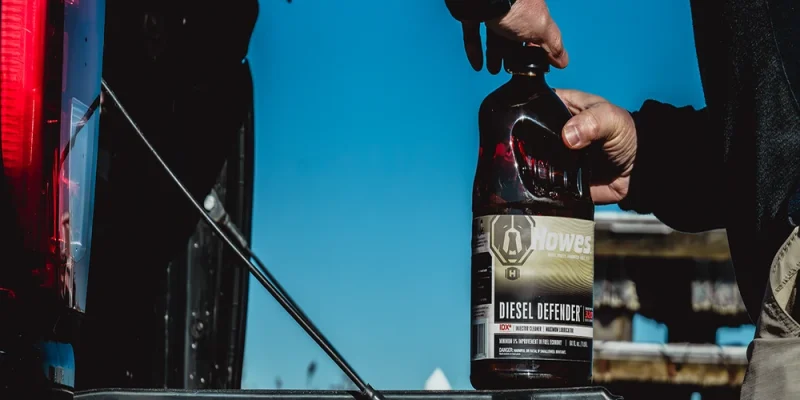
Diesel Defender is a lubricator and injector cleaner with an IDX4 detergent. Howes says it works safely at any time of year alongside Diesel Treat.
Meaner Power Kleaner is a one-tank deep clean. It suits a truck with high mileage or an unknown maintenance history.
Your Winter Checklist
Print this list or save it on your phone.
- Check your fuel filter and replace it if it is old.
- Treat every tank once the forecast nears 20°F.
- Use the double dose that Howes lists for pickups.
- Keep the tank half full or more.
- Store a bottle of Diesel Lifeline in the cab.
Gelled diesel is a problem you can avoid. Know the numbers, treat your fuel early, and carry a rescue product. That plan gives you the best chance of starting your truck on the coldest morning.







Comments